The Real Cost of Deferred Fleet Maintenance



When margins tighten, maintenance is one of the first budgets fleets squeeze. Fuel climbs, rates stay thin, and pushing a PM back a few weeks looks like an easy way to protect cash. Deferred fleet maintenance feels free in the moment. It is one of the most expensive decisions a fleet can make.
Why fleets defer maintenance
Every deferral is rational in isolation. Cash is tight, the truck is still running, the shop is backed up, or the unit is booked solid and nobody wants to pull it from service. The pressure is real, and industry leaders are already flagging it: trucking association executives have warned that carriers hauling below cost may start postponing preventive maintenance just to stay afloat.
The logic breaks down because a deferred PM does not remove the cost. It moves the cost forward and adds interest.
Deferral moves the cost, it does not remove it
A PM you skip today becomes a roadside failure later, and the roadside version is far more expensive. Unplanned downtime runs between $448 and $760 per vehicle per day once you count the tow, the missed load, the idle driver, and the disruption to the rest of the schedule. Across a year that adds up to roughly $3,500 to $5,200 per vehicle in downtime alone.
The frustrating part is how avoidable it is. Analyses of fleet breakdowns put the share of preventable failures around 78 percent. Most of what strands a truck was catchable at a scheduled service that got pushed.
One deferral becomes a backlog
Deferral compounds. Push one PM and the next service arrives with the first still undone, so the technician now faces the scheduled work plus whatever failed in the meantime. Compliance slips, the backlog grows, and the fleet drifts out of planned maintenance and into reactive repair, which is the most expensive way to run.
Consistent preventive maintenance cuts overall maintenance costs by 20 to 30 percent. That saving is exactly what a fleet gives up when PMs start sliding.
Deferral is most dangerous on an older fleet and in winter
The risk is not spread evenly. Older vehicles fail more often and consume a disproportionate share of repair spend, so deferring on a high-mileage unit is a bigger gamble than on a new one. The fleet mix is trending that way too. Analysts expect 11-to-20-year-old trucks to grow faster than newer trucks through the second half of the decade, which puts more assets in the band where skipped maintenance bites hardest.
Season matters as well. Cold weather exposes marginal batteries, air systems, and cooling components. A deferral that would have been survivable in July turns into a January breakdown.
How to defer less without spending more
The answer is not to throw money at maintenance you do not need. It is to defer by data instead of by guesswork, so the only services that wait are the ones that safely can.
Two things make that possible. The first is prediction. Machine-learning models can flag a component failure 20 to 45 days out with 85 to 95 percent accuracy by reading the telematics data your trucks already produce, and Deloitte has reported that predictive programs can cut breakdowns by up to 70 percent. AI Predictive Maintenance does exactly that, predicting when components will fail so your team intervenes before a failure becomes downtime.
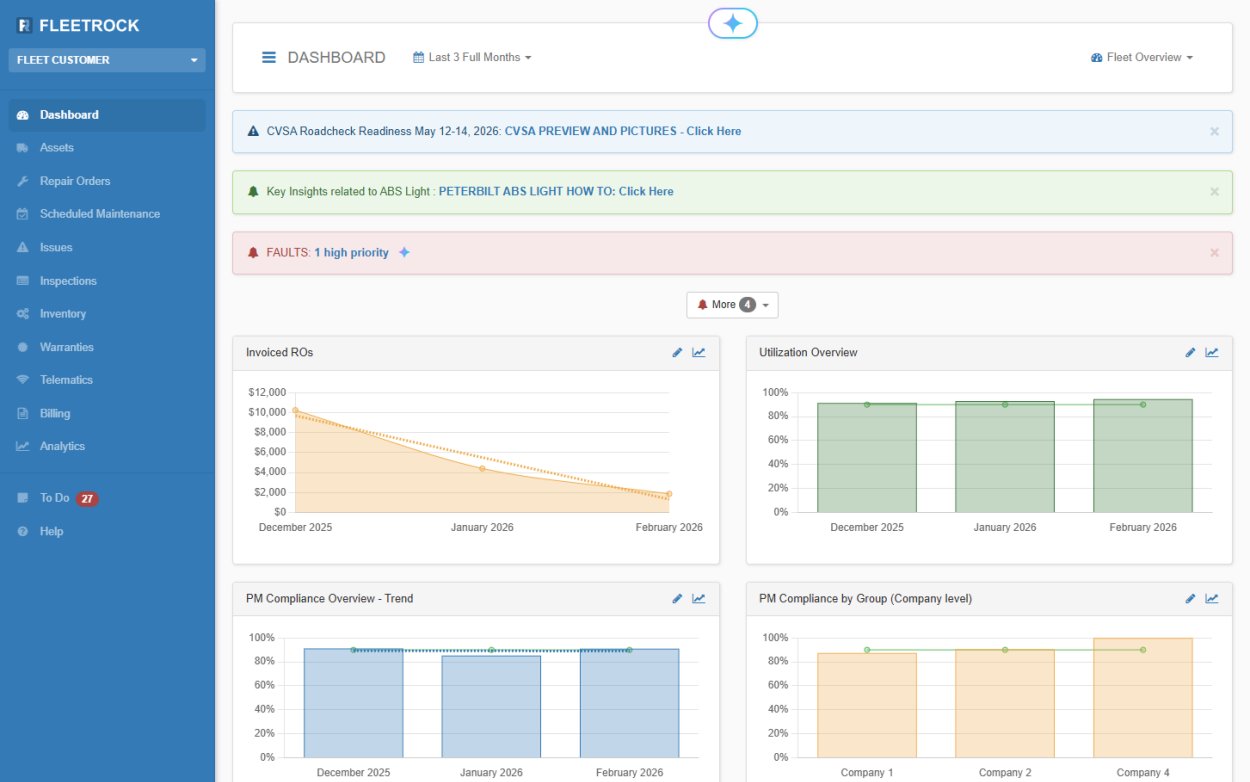
The second is PM compliance visibility. You cannot protect what you cannot see. Scheduled maintenance tracking shows which units are due, coming due, and overdue in real time, so a slipped PM becomes a decision you make on purpose rather than a surprise you discover at the roadside.
What it looks like when you stop deferring
Southwind, a home services operator running 20 companies, moved its fragmented maintenance onto one platform and raised preventive maintenance compliance by 38 percent, with uptime climbing 13 percent as a result. Across its customer base, Fleetrock sees a 50 percent average gain in uptime. Those numbers are the mirror image of the deferral trap. When PM holds, trucks stay available and the expensive failures stop happening.
The cheapest repair is the one you schedule
Deferring maintenance to save money is a bet that the failure will not arrive before you can afford it. On an aging fleet in a tight market, that is a bet you lose more often than you win. Decide what to defer with data, keep your PM compliance visible, and let prediction catch the failures that will not wait.
See how Fleetrock predicts failures before they become downtime on the Fleetrock AI page.